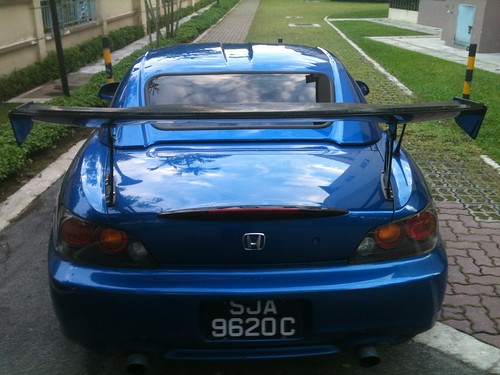
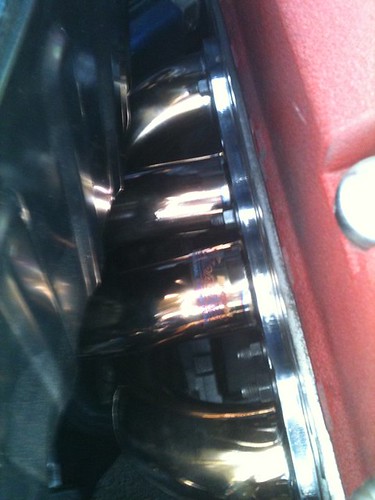
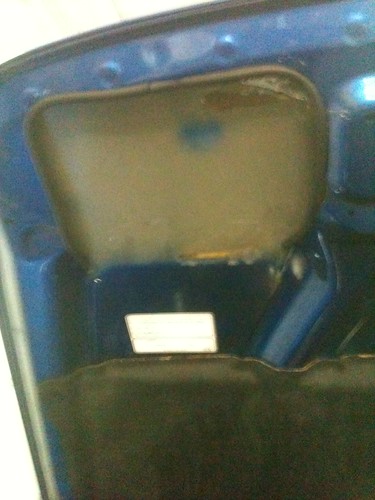
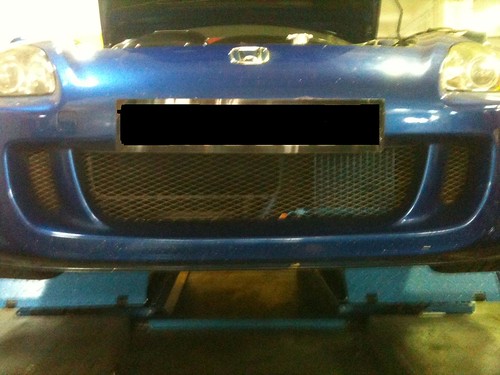
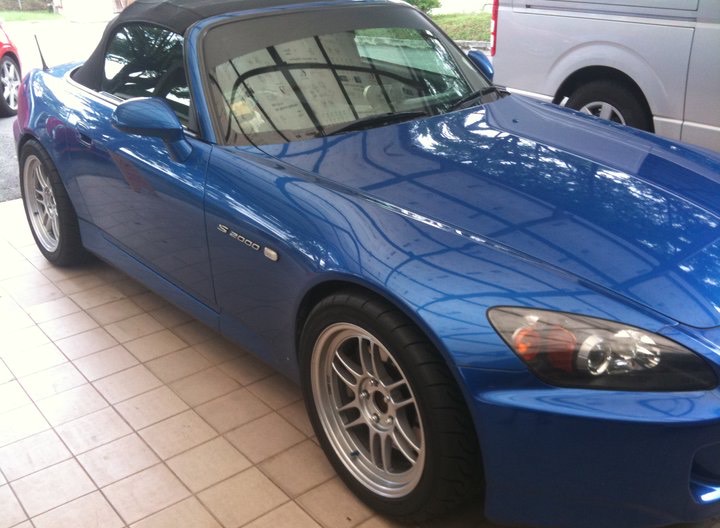
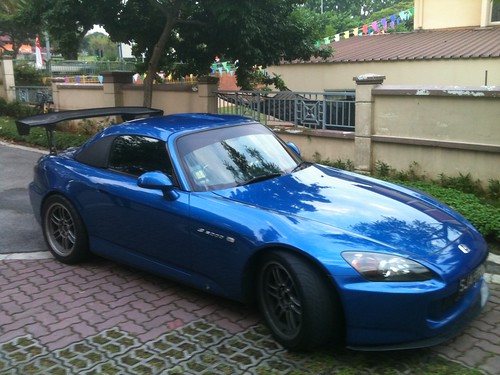
The mechanical setup of the car has been pretty much finalized with the addition of the Mugen Hardtop I have fitted to my car. The only few things remaining would be minor tweaks like corner weighting, repair of my brake caliper seals due to wear and tear etc. The key benefit would be the aerodynamic improvement of the hard top versus the flapping in the wind of the rib framed soft top. I also removed the soft top entirely including the motors to lighten the car as much as possible. I had the option of spraying the entire car together with the hardtop but frankly I was too lazy to do so considering how pitted the paint would eventually become from track and high speed travel paint chips. Here are some pics (pardon the low quality iphone pics):
So far, the setup would be as follows:
J's Racing Exhaust Header
J's Racing Dual Titanium Exhaust 70RS
Invidia 70MM test pipe (for track use only, stock cat on for street)
Password JDM Carbon Intake
Hondata Flashpro
Odyssey PC680 battery
Toda Baffled Oil Pan
Greddy NS1310G oil cooler
5zigen ProRacer oil catch tank
Koyo Aluminium Radiator
Brake Ducts customized to my specifications by Lye Design
Ferodo DS2500
HPI Brake Hoses
SPC Front Camber Joints
Tein Super Racing Circuit Master Coilovers
AP1 Flywheel
GT Motoring 4.44 Final Drive
Enkei RPF1 Rims
Advan AD08 tyres
APR Carbon front splitter with custom bracket
M and M Honda Thermostat
Mugen Radiator Fan Switch
Mugen FRP Hardtop
Voltex Type II GT Wing with Gurney Flap
Recaro Profi SPG driver's side seat
Mugen seat rails
Defi gauges: Exhaust Temperature, Oil Temperature, Oil Pressure, Water Temperature
Defi Tachometer
Motul Chrono 10w-40 engine oil
Motul RBF660 brake fluid
Moty's M409M 75W-140 Gear oil for my gearbox and differential
I've kept everything else, which isn't mentioned, stock to ensure that parts are always available and running costs are being kept reasonable. By not having a budget and sticking to it, the amateur runs significant risk of overspending with the constant lure of better performance and reliability. This is unacceptable to me as it would go against my ethos of what I had set out to accomplish and the constant expenditure (My budget is limited of course!) would ultimately limit my opportunity to track as often as I need on a fixed setup in order to isolate where I need to improve as a driver.
A rough budget of recurring costs would include the factoring of the following:
Brake pads
Brake discs
Potential repairs
Alignment adjustments
Additional oil/fluid changes
End 2012 or 2013 seems the earliest that I can begin to track as committments take precedence so I will patiently await the return to the track. Let's see then how power, light weight, aero modifications and combined with tuning my tyre/suspension setup with the proper tools delivers on the track. I expect to be formally taking part in competition once I have become consistent as a driver.
Sunday, August 28, 2011
Thursday, August 4, 2011
Maintenance problems, just part and parcel of journey...
Recently some issues have cropped up which I attribute to the normal maintenance problems that come with a long term tracked car. My brake pedal has gone soggy for a bit and replacing the worn pads and discs with newer 2nd hand spares havent solved it. A cheaper brake pump repair kit hasn't really worked so I may have resort to a whole new brake master pump.
My brakes seem to engage one first and then another which points to a potential sticking caliper on one side of the car. A brake seal repair kit is the solution but thats got to be ordered and it would take time to come in not to say for it to be fitted.
My aircon compressor clutch was jammed and I had no choice but to resort to getting a reconditioned one so that I could get the car going. Although its a 2nd hand unit, it seems to be running fine.
Finally, temperatures seemed to get high on my car and at first I thought it was the thermostat so I swopped it out for a low temperature thermostat with a low temperature fan switch. I then found that coolant temps rising on idle and pinpointed it to a failed radiator fan. I swopped out both fans for new units as this is probably due since my car is about 115,000kms to date.
A couple of hundred spent in total in maintenance but it goes a long way to keeping the car track ready for next year. At least I can focus fully on tracking without delays then! :)
My brakes seem to engage one first and then another which points to a potential sticking caliper on one side of the car. A brake seal repair kit is the solution but thats got to be ordered and it would take time to come in not to say for it to be fitted.
My aircon compressor clutch was jammed and I had no choice but to resort to getting a reconditioned one so that I could get the car going. Although its a 2nd hand unit, it seems to be running fine.
Finally, temperatures seemed to get high on my car and at first I thought it was the thermostat so I swopped it out for a low temperature thermostat with a low temperature fan switch. I then found that coolant temps rising on idle and pinpointed it to a failed radiator fan. I swopped out both fans for new units as this is probably due since my car is about 115,000kms to date.
A couple of hundred spent in total in maintenance but it goes a long way to keeping the car track ready for next year. At least I can focus fully on tracking without delays then! :)
Sunday, June 12, 2011
The priorities of life
One of the matters that has occupied my mind lately is how the fun of racing and motorsports must often take a backseat to the priorities of life. In my life, there has been almost a single minded focus on my car as a hobby and I have had recently to re-align myself to focus on the priorities which are clear and present before indulgent expenditures on my car.
To put it clearly into perspective, there are compromises in every facet of one's life and there must be a appropriate balance between your hobby versus priorities of daily living. I've decided to put my energies and resources into my personal & work matters first and thus will have to put this project on a temporary hold until those issues are attended to properly which may take close to a year. To recognise that a hobby is merely for entertainment is simply to look at it critically and to put things in their proper place.
Thankfully, nearly 90% of my expenditures to date are complete and I need no longer wonder how much more I could build my car up to. That is an important step as I have already decided some time ago to stop at this current juncture and focus on simple maintenance once the current level of modifications are finished. I've also put forward my budgeting for yearly tracking and consumables in order to ensure I'm very comfortable with expenditures as regular tracking can take it toll on the budget.
I've seen many go bust due to over-indulgence and lack of prioritization on personal matters versus hobby expenditures so I'd like to take a leaf from that book before heading down that nasty path. Thankfully, I've not needed to take the drastic step some others have had to due to compromises and I'm indeed mindful of how lucky I am. In order to enjoy my hobby in the future, self moderation is due so I can have a longer time to enjoy motorsports and tracking in my life.
To put it clearly into perspective, there are compromises in every facet of one's life and there must be a appropriate balance between your hobby versus priorities of daily living. I've decided to put my energies and resources into my personal & work matters first and thus will have to put this project on a temporary hold until those issues are attended to properly which may take close to a year. To recognise that a hobby is merely for entertainment is simply to look at it critically and to put things in their proper place.
Thankfully, nearly 90% of my expenditures to date are complete and I need no longer wonder how much more I could build my car up to. That is an important step as I have already decided some time ago to stop at this current juncture and focus on simple maintenance once the current level of modifications are finished. I've also put forward my budgeting for yearly tracking and consumables in order to ensure I'm very comfortable with expenditures as regular tracking can take it toll on the budget.
I've seen many go bust due to over-indulgence and lack of prioritization on personal matters versus hobby expenditures so I'd like to take a leaf from that book before heading down that nasty path. Thankfully, I've not needed to take the drastic step some others have had to due to compromises and I'm indeed mindful of how lucky I am. In order to enjoy my hobby in the future, self moderation is due so I can have a longer time to enjoy motorsports and tracking in my life.
Tuesday, May 10, 2011
Modifications Update
I'm currently closing in on my goal of just under 300bhp Normally Aspirated (NA) with the addition of two power adding modifications, namely the Password JDM Carbon Fibre Intake and the J's Racing Exhaust Manifold. These additions along with the J's Racing FX 70RS Titanium Dual exhaust will be tuned in 1-2 weeks with a Hondata Flashpro with the goal of getting to 280~290bhp on engine. Here are some iPhone pictures (do forgive the poor quality of the iPhone camera):
So far the feedback I have on the PWJDM intake is that fitment is not easy in the slightest requiring hood cutting as per this pic:
A spacer on the bonnet joint end was also required to ensure proper closing of the bonnet. My oil cooler had to be relocated and my brake ducting also needs to be re-aligned. In the picture below you can see how the funnels have been relocated to relatively ineffective positions.
As per an s2ki.com posting, there seems to be a penchant for this bonnet to suck in alot of debris and I will check this periodically, say every month or two, to validate this claim.
The gains are feeling good from the seat of the pants feeling and people who have driven my car before and after the intake + header modification are noticeably impressed by the increase in low-mid range torque. I can't discern much higher rev range outperformance and a look at a posting on the PWJDM intake by gernby of s2ki.com does hint that the higher end performance may only be fully unearthed by a custom tune which I will be getting done via Hondata Flashpro.
The next modification which is slated to be completed in July-August would be an aerodynamic cum lightening modification. The targeted weight of the current project would be ~1180kgs with a half tank of petrol.
A spacer on the bonnet joint end was also required to ensure proper closing of the bonnet. My oil cooler had to be relocated and my brake ducting also needs to be re-aligned. In the picture below you can see how the funnels have been relocated to relatively ineffective positions.
As per an s2ki.com posting, there seems to be a penchant for this bonnet to suck in alot of debris and I will check this periodically, say every month or two, to validate this claim.
The gains are feeling good from the seat of the pants feeling and people who have driven my car before and after the intake + header modification are noticeably impressed by the increase in low-mid range torque. I can't discern much higher rev range outperformance and a look at a posting on the PWJDM intake by gernby of s2ki.com does hint that the higher end performance may only be fully unearthed by a custom tune which I will be getting done via Hondata Flashpro.
The next modification which is slated to be completed in July-August would be an aerodynamic cum lightening modification. The targeted weight of the current project would be ~1180kgs with a half tank of petrol.
Monday, April 4, 2011
Non Staggered Setup Thoughts (Updated 8 Feb 2020)
Some S2000 owners, including myself, have gone to a setup where the front tyres are the same as the rears called the non staggered setup. This may seem a step towards increasing the high potential for snap oversteer as many S2000 owners have experienced yet based on my experience, it has delivered so much in gains that I would not look back to regular staggered setup, where front tyres are narrower than the rears, until I can find evidence that the staggered setup performs better.
Update: This is how the car looked when the non staggered Enkei wheels were fitted
Let's look at the S2000 setup in stock form. With 215/45/17 tyres up front and 245/40/17 tyres out in the rear, the feel I get is that the intial turn-in is lacking in grip. The result of this is that the driver tends to add more lock to get the car to turn and when the car finally responds, there is excessive steering lock and the tail of the car snaps around. This tendency remains even when camber angles are increased to give more grip to the fronts and it is my thought that this is wholly due to front tyres that are too skinny.
Update: There might be a tendency to overcook the front tyres over many laps during turn in as with the skinnier profile of the stock tyres, the tyre might have less ability to handle the heat built up.
When I shifted to a non staggered tyre setup with front tyres as wide as the rear, the turn in was excellent. Feedback did seem a little numb but you would pretty much know how much grip there was as the steering was still communicative. At higher speeds, due to the high amount of rear lift the S2000 generates along with the fact that I had fitted a large front splitter, the front gripped far more than the back and resulted in a rather white knuckled ride. This left me with doubts about how the non staggered setup had upset the natural balance of the car.
Update: The slightly "numb" feel might be due to the relatively thicker profile of the front tyre and sidewall stiffness of the tyre I was using at that time. In retrospec, the splitter seemed to be the main reason for oversteer at higher speeds and the lower speeds "oversteer" tendency could be handled by relatively less steering input than stock.
For those seeking a budget non staggered setup, 2 rear wheels of the AP2 might be used on the fronts with same size rear and front tyres. There might be clearance issues at full lock which can be solved with a spacer or with steering lock limiters.
I subsequently fitted a high mount GT wing to balance the tail of the car and the result was phenomenal. Not only did the rear lift get cancelled out, I also retained the excellent turn-in characteristics of the car. This was far more pronounced when I got to the track. When turning in, the car would simply grip and go and I had no need to add any excessive lock but was rather using far less steering lock than before which is easily seen as much more efficient. In the slower corners, I was able to turn in sharply and get the car to rotate (as the rear wing grip was far less due to lower speeds) while at higher speeds, the slight oversteer would change to slight understeer as the balance of grip shifted to the rear. Braking was also a much more stable affair with the increased stance of the car.
I was hampered by a leaking brake master pump, torn in half shifter bush, leaking clutch pump, overly understeering alignment & wrong tyre pressures at the latest track day I attended. This resulted in only a very slight improvement in my personal best laptimes which was a definite disappointment. However, I am confident that after the repairs, the car will be able to hit the benchmark times I have aided by the transformed characteristics of the car.
Even though it seems counter intuitive to conventional wisdom (you can't imagine how many "old birds" of the tracking scene scoffed my new setup) seeing how many performance cars have rear tyres much wider than the front, deeper analysis into racing cars seems to favour the non staggered setup. Many racing cars have front track & tyres as wide or wider than the front to aid their turn-in and front grip with the rear aero dynamics compensating for rear grip. Although its hard to tell on paper which is better, having experienced the difference on the road and track, I am definitely of the opinion that non staggered is the way to go for track-biased cars. The only caveat would be that the driver needs to be experienced enough to measure his steering inputs accordingly.
Update: Many years have transpired since I embarked on the non staggered setup and when I initially did so, the setup was viewed with apprehension and sometimes mocked. By now, it has become the de facto go to setup that owners see as necessary for best for the track. As they say, "Time will tell" and it has been clearly evidenced from tests. Any car can be made to be setup best for a staggered or non staggered setup but the generally easy to find setup plus the benefit of being able to cross rotate for even wear for the non staggered setup has clearly won over many owners.
Considerations on non staggered fitment are the following:
1. Rolling and pulling of the fenders are mostly necessary (there seems no point in my opinion to run tucked in offsets just for fender clearance when the increased track of lower offset will deliver great gains)
2. Camber requires to be to tuned to your driving style (it seems necessary to have a proper data to support better alignment to optimize the alignment)
3. Improved aero i.e. GT wing is necessary (you will be resetting the balance of the car and an adjustable efficient wing will go a long way to ensuring your setup is effective)
4. Some rubbing of fender liners and suspension cars will be experienced (this is an eventuality non staggered owners will have to accept)
5. Fender tab relocation and bumper trimming is necessary(again this is necessary to prevent rubbing of your tyres)
Update:
For 1. - Gains from a lower offset come with the trade off of a change of scrub radius which will change steering effort and some response of the steering. I would say its best for the owner to read a bit more on this to see if this is something they can accept which may change the driving feel for them.
The lack of wide choice of rims in high offset (the Enkei PF01SS is one of the few +60 wheels easily available unless you would like to spring big money for forged Rays wheels) says to me that doing rolling and pulling actually helps widen the choice available for wheel upgrades.
Plenty of people told me the Enkei RPF1 17x9 +45 offset fit easily with rolling and camber resulting in my choice to get them but I was pretty surprised to see the actual fitment on stock fenders with 255/40/17 AD08 tyres. Please stop saying they fit so easily!
For 2, - Alignment is a beaten to death topic and there is an immense trove of information on recommended settings for staggered or non staggered setups. For performance oriented setups, getting help to properly set up the car saves you tons of guesswork and wasted trips to the track.
For 3. As earlier mentioned, I'd attribute the higher speed handling change to the splitter so the wing is primarily to balance that change. It is important to note that the design of the underbody of the S2000 generates a large amount of lift leading to rather sketchy handling at higher speed, apparently lifting the tail up. A smallish Type S size wing can help settle the tail quite nicely without significant drag penalty.
The ultimate caveat here for fitment of a non staggered setup is that owners who want the aesthetic appeal of the car maintained may be disappointed. To clear non staggered setups, the car may be raised slightly, may need body work, may have slightly wavy paint due to rolling & cutting, may have protuding tyres etc. Everyone chooses how they want their car to be and I think its important that owners know the impact of non staggered in the aesthetic sense before they embark on this journey. The track-crazy S2000 drivers wouldn't be too bothered by these sacrifices as the on-track performance would likely be sufficient to compensate.
Update: One further thought regarding the work required for the non staggered setup to pay off might be that the choice of brake upgrades would be wider and eliminating the need for spacers. The RPF1 in this offset will not fit a brake kit due to the inset spokes. The Enkei Racing GTC 01 I currently run has plenty of room for big brake kit due to the way the spokes are designed.
I welcome any non staggered owners to discuss their setups openly or in private and hope my anecdotal thoughts are of use to any readers out there :)
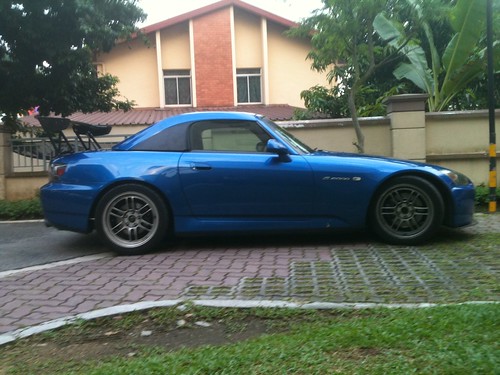
Update: This is how the car looked when the non staggered Enkei wheels were fitted
Side profile
Front poke from the side
Rear poke from the side
Let's look at the S2000 setup in stock form. With 215/45/17 tyres up front and 245/40/17 tyres out in the rear, the feel I get is that the intial turn-in is lacking in grip. The result of this is that the driver tends to add more lock to get the car to turn and when the car finally responds, there is excessive steering lock and the tail of the car snaps around. This tendency remains even when camber angles are increased to give more grip to the fronts and it is my thought that this is wholly due to front tyres that are too skinny.
Update: There might be a tendency to overcook the front tyres over many laps during turn in as with the skinnier profile of the stock tyres, the tyre might have less ability to handle the heat built up.
When I shifted to a non staggered tyre setup with front tyres as wide as the rear, the turn in was excellent. Feedback did seem a little numb but you would pretty much know how much grip there was as the steering was still communicative. At higher speeds, due to the high amount of rear lift the S2000 generates along with the fact that I had fitted a large front splitter, the front gripped far more than the back and resulted in a rather white knuckled ride. This left me with doubts about how the non staggered setup had upset the natural balance of the car.
Update: The slightly "numb" feel might be due to the relatively thicker profile of the front tyre and sidewall stiffness of the tyre I was using at that time. In retrospec, the splitter seemed to be the main reason for oversteer at higher speeds and the lower speeds "oversteer" tendency could be handled by relatively less steering input than stock.
For those seeking a budget non staggered setup, 2 rear wheels of the AP2 might be used on the fronts with same size rear and front tyres. There might be clearance issues at full lock which can be solved with a spacer or with steering lock limiters.
I subsequently fitted a high mount GT wing to balance the tail of the car and the result was phenomenal. Not only did the rear lift get cancelled out, I also retained the excellent turn-in characteristics of the car. This was far more pronounced when I got to the track. When turning in, the car would simply grip and go and I had no need to add any excessive lock but was rather using far less steering lock than before which is easily seen as much more efficient. In the slower corners, I was able to turn in sharply and get the car to rotate (as the rear wing grip was far less due to lower speeds) while at higher speeds, the slight oversteer would change to slight understeer as the balance of grip shifted to the rear. Braking was also a much more stable affair with the increased stance of the car.
I was hampered by a leaking brake master pump, torn in half shifter bush, leaking clutch pump, overly understeering alignment & wrong tyre pressures at the latest track day I attended. This resulted in only a very slight improvement in my personal best laptimes which was a definite disappointment. However, I am confident that after the repairs, the car will be able to hit the benchmark times I have aided by the transformed characteristics of the car.
Even though it seems counter intuitive to conventional wisdom (you can't imagine how many "old birds" of the tracking scene scoffed my new setup) seeing how many performance cars have rear tyres much wider than the front, deeper analysis into racing cars seems to favour the non staggered setup. Many racing cars have front track & tyres as wide or wider than the front to aid their turn-in and front grip with the rear aero dynamics compensating for rear grip. Although its hard to tell on paper which is better, having experienced the difference on the road and track, I am definitely of the opinion that non staggered is the way to go for track-biased cars. The only caveat would be that the driver needs to be experienced enough to measure his steering inputs accordingly.
Update: Many years have transpired since I embarked on the non staggered setup and when I initially did so, the setup was viewed with apprehension and sometimes mocked. By now, it has become the de facto go to setup that owners see as necessary for best for the track. As they say, "Time will tell" and it has been clearly evidenced from tests. Any car can be made to be setup best for a staggered or non staggered setup but the generally easy to find setup plus the benefit of being able to cross rotate for even wear for the non staggered setup has clearly won over many owners.
Considerations on non staggered fitment are the following:
1. Rolling and pulling of the fenders are mostly necessary (there seems no point in my opinion to run tucked in offsets just for fender clearance when the increased track of lower offset will deliver great gains)
2. Camber requires to be to tuned to your driving style (it seems necessary to have a proper data to support better alignment to optimize the alignment)
3. Improved aero i.e. GT wing is necessary (you will be resetting the balance of the car and an adjustable efficient wing will go a long way to ensuring your setup is effective)
4. Some rubbing of fender liners and suspension cars will be experienced (this is an eventuality non staggered owners will have to accept)
5. Fender tab relocation and bumper trimming is necessary(again this is necessary to prevent rubbing of your tyres)
Update:
For 1. - Gains from a lower offset come with the trade off of a change of scrub radius which will change steering effort and some response of the steering. I would say its best for the owner to read a bit more on this to see if this is something they can accept which may change the driving feel for them.
The lack of wide choice of rims in high offset (the Enkei PF01SS is one of the few +60 wheels easily available unless you would like to spring big money for forged Rays wheels) says to me that doing rolling and pulling actually helps widen the choice available for wheel upgrades.
Plenty of people told me the Enkei RPF1 17x9 +45 offset fit easily with rolling and camber resulting in my choice to get them but I was pretty surprised to see the actual fitment on stock fenders with 255/40/17 AD08 tyres. Please stop saying they fit so easily!
Front view of front poke, clear enough to see how much they stick out
Front poke top view. Without modification you WILL mess the hell out of your front fender on a big compression on your suspension and ruin BOTH fender plus tyre.
Rear poke seen from the front. It doesn't seem all that much bit I think its harder to work the rear than it is the front from feedback from the body shop I went to.
Rear poke seen from the rear view. You might be able to make out that my rear fenders are already very slightly pulled and rolled but at that time I was still having rubbing on big dips in the road when the suspension compressed a lot. A more stiffly sprung suspension might be able to get away with less fender work.
For 2, - Alignment is a beaten to death topic and there is an immense trove of information on recommended settings for staggered or non staggered setups. For performance oriented setups, getting help to properly set up the car saves you tons of guesswork and wasted trips to the track.
For 3. As earlier mentioned, I'd attribute the higher speed handling change to the splitter so the wing is primarily to balance that change. It is important to note that the design of the underbody of the S2000 generates a large amount of lift leading to rather sketchy handling at higher speed, apparently lifting the tail up. A smallish Type S size wing can help settle the tail quite nicely without significant drag penalty.
The ultimate caveat here for fitment of a non staggered setup is that owners who want the aesthetic appeal of the car maintained may be disappointed. To clear non staggered setups, the car may be raised slightly, may need body work, may have slightly wavy paint due to rolling & cutting, may have protuding tyres etc. Everyone chooses how they want their car to be and I think its important that owners know the impact of non staggered in the aesthetic sense before they embark on this journey. The track-crazy S2000 drivers wouldn't be too bothered by these sacrifices as the on-track performance would likely be sufficient to compensate.
Update: One further thought regarding the work required for the non staggered setup to pay off might be that the choice of brake upgrades would be wider and eliminating the need for spacers. The RPF1 in this offset will not fit a brake kit due to the inset spokes. The Enkei Racing GTC 01 I currently run has plenty of room for big brake kit due to the way the spokes are designed.
I welcome any non staggered owners to discuss their setups openly or in private and hope my anecdotal thoughts are of use to any readers out there :)
Monday, February 14, 2011
Service & Maintenance for my S2000 and suggested track modifications
Coming from an older version WRX, the excellent reliability of a normally aspirated Honda S2000 was a real comfort. The only maintenance parts (wear & tear excluding regular servicing parts such as spark plugs) I've needed for the past 3 years of ownership are the following:
1. a new battery - pretty cheap to replace
2. air-con condensor coil - a few hundred solved it
3. a bulb in the air-con display panel - never bothered replacing it
4. an ABS sensor (probably got hit by a rock during tracking) - about a 100 only
5. Pedal Position sensor - under 200
And that's it. None of these even required my car to be placed overnight for repairs.
The stock parts are very reliable and I've never changed my suspension mounts, gearbox mounts, engine mounts or wheel bearings which gives you a clue how suited the S is in entirety for use as a track machine.
For the folks who want to know what might be used to service their cars, here is my list:
1. NGK Iriway spark plugs
2. Motul RBF600 brake fluid
3. For Rear Differential - Moty's 75w/140 rear differential fluid or Motul Gear 300 FF LSD 75w/90 or ATS diff oil 85w/90
4. For Gearbox - Motul Gear 300 or Honda MTF III
5. For engine - Motul 300 V
6. For engine oil filter - Previously Honda PCX filter (Note: after fitting a Greddy oil cooler, due to the thickness of the sandwich plate, the Honda filter will not sit as securely and have less threads to lock the filter in. It is known that engine vibrations can dislodge even a well torqued oil filter) Now Juran oil filter with deeper thread
7. Brake rotors - Stock (OEM rotors work perfectly and cracking can be mitigated by brake modifications, there is hardly need for a full big brake kit unless you are running huge power)
8. Brake pads - Ferodo DS2500 or Seidoya N1-500
9 Clutch - The stock clutch is both reliable and cost effective, there is no need for single/twin plate clutches
For modifications relating to track use, here are some suggested items you would want to consider for your S2000 to enhance your tracking experience and increase safety.
1. Oil cooler - I am using a Greddy turbo oil cooler core and the additional cooling is a huge bonus on Sepang International Circuit where track temps >50deg C
2. Brake pads - Stock brake pads WILL disintegrate on the track, better pads are essential
3. Brake lines - There is no proof that stock brake lines are unsuitable for track use but for peace of mind, stainless steel brake hoses are cheap insurance
4. Brake Fluid - Good brake fluid is a must as the stock fluid will boil very quickly
5. Brake Ducting - This is a commonly overlooked modification. Here is my article on the benefits for brake ducting for a track day enthusiast.
6. Baffled oil pan - This is a good and affordable modification if you are an avid trackie by reducing the chance of oil starvation in high G situations on the track. I'm currently running a Toda pan.
I hope this is useful to any S2000 owners for maintenance and track related modifications.
1. a new battery - pretty cheap to replace
2. air-con condensor coil - a few hundred solved it
3. a bulb in the air-con display panel - never bothered replacing it
4. an ABS sensor (probably got hit by a rock during tracking) - about a 100 only
5. Pedal Position sensor - under 200
And that's it. None of these even required my car to be placed overnight for repairs.
The stock parts are very reliable and I've never changed my suspension mounts, gearbox mounts, engine mounts or wheel bearings which gives you a clue how suited the S is in entirety for use as a track machine.
For the folks who want to know what might be used to service their cars, here is my list:
1. NGK Iriway spark plugs
2. Motul RBF600 brake fluid
3. For Rear Differential - Moty's 75w/140 rear differential fluid or Motul Gear 300 FF LSD 75w/90 or ATS diff oil 85w/90
4. For Gearbox - Motul Gear 300 or Honda MTF III
5. For engine - Motul 300 V
6. For engine oil filter - Previously Honda PCX filter (Note: after fitting a Greddy oil cooler, due to the thickness of the sandwich plate, the Honda filter will not sit as securely and have less threads to lock the filter in. It is known that engine vibrations can dislodge even a well torqued oil filter) Now Juran oil filter with deeper thread
7. Brake rotors - Stock (OEM rotors work perfectly and cracking can be mitigated by brake modifications, there is hardly need for a full big brake kit unless you are running huge power)
8. Brake pads - Ferodo DS2500 or Seidoya N1-500
9 Clutch - The stock clutch is both reliable and cost effective, there is no need for single/twin plate clutches
For modifications relating to track use, here are some suggested items you would want to consider for your S2000 to enhance your tracking experience and increase safety.
1. Oil cooler - I am using a Greddy turbo oil cooler core and the additional cooling is a huge bonus on Sepang International Circuit where track temps >50deg C
2. Brake pads - Stock brake pads WILL disintegrate on the track, better pads are essential
3. Brake lines - There is no proof that stock brake lines are unsuitable for track use but for peace of mind, stainless steel brake hoses are cheap insurance
4. Brake Fluid - Good brake fluid is a must as the stock fluid will boil very quickly
5. Brake Ducting - This is a commonly overlooked modification. Here is my article on the benefits for brake ducting for a track day enthusiast.
6. Baffled oil pan - This is a good and affordable modification if you are an avid trackie by reducing the chance of oil starvation in high G situations on the track. I'm currently running a Toda pan.
I hope this is useful to any S2000 owners for maintenance and track related modifications.
Sunday, January 9, 2011
Competitor Analysis
The reference cars I'm using to bench are the Cayman S & Exige S. It is true that the S2000 will never be any other car other than itself so no amount of modification can make the S2000 like the Cayman or Exige. That said, achieving the same or better track times on a street legal modified S2000 that the reference cars can do on my car would firmly put my car as a viable alternative to the 2 cars with the notable exception being some lack of refinement and less badge appeal.
The Cayman S in its current iteration produces 320bhp of power & 340N.m of torque while lugging around 1340kg of curb weight. It also benefits from excellent drag coefficient of 0.29 & a virtually flat underbody design adding to its slipperiness at higher wind speeds combined with less lift.
The Exige S is renowned, as all Lotus cars are, for its impressive lightweight body which is only about 933kgs. This lightweight combined with 218bhp & 215N.m of torque makes for a car thats built as an out and out cornering machine. A completely flat underbody with a well balanced wing and front aero make this car virtually track tuned right out of the box.
Both cars are mid engined and rear wheel drive with excellent static front to rear weight balance. The track width of both cars are 1507-1528 which contribute to their excellent stance for cornering. Shod with sticky tyres, even semi slicks in the case of the Exige S, right out of the factory, the cornering G's generated are nothing short of phenomenal resulting in excellent track timings on Sepang. I have spoken to a local racer who quoted a stock Exige S as being capable of around 2:32 while my best guess on a stock Cayman S would be at least around 2:37.
Now that we know where we stand on the comparison from car to car in terms of track times, its time to have a look at what the fastest cars in actual competition are. A recent time attack at Sepang had some machines doing some very impressive times. These would be ~2:39 for NA FF Street Tyres & 2:33 for Turbo 4wd Street Tyres. A time within this ball park would be decent and probably something I will be shooting for. I have left out the Semi Slick class as this is not a class I want to compete or benchmark against and the NA RWD is so under represented that there are virtually no proper benchmarks for me to form a reference against.
S2000 times at Sepang have been seldom talked about probably due to scarcity of the car and difficult to reference since it is not part of the local culture to be upfront about the full disclosure of the modifications on the car when a certain lap time was achieved. Nevertheless, I have managed to be privy to the times of a fully stock S2000 doing about 2:45-2:46 & a modified street tyred (with engine works) S2000 doing about 2:35-2:36. These times could be taken as a reference for me to consider my progress.
All in all, the stated comparisons are only to serve as a general guide of how I should view my progress. As I will probably not have completed my build til much later this year, to be truly competitive is left til I get more seat time at the track & complete the setup proper (along with appropriate settings). As always, my budget & restriction of time to track due to my job (along with comparative lack of natural driving talent!) will be the barriers I will need to surmount whilst trying to hit the objectives stated. Either way, the S and me are going to have alot of fun getting there :)
Cheers to an excellent 2011!
The Cayman S in its current iteration produces 320bhp of power & 340N.m of torque while lugging around 1340kg of curb weight. It also benefits from excellent drag coefficient of 0.29 & a virtually flat underbody design adding to its slipperiness at higher wind speeds combined with less lift.
The Exige S is renowned, as all Lotus cars are, for its impressive lightweight body which is only about 933kgs. This lightweight combined with 218bhp & 215N.m of torque makes for a car thats built as an out and out cornering machine. A completely flat underbody with a well balanced wing and front aero make this car virtually track tuned right out of the box.
Both cars are mid engined and rear wheel drive with excellent static front to rear weight balance. The track width of both cars are 1507-1528 which contribute to their excellent stance for cornering. Shod with sticky tyres, even semi slicks in the case of the Exige S, right out of the factory, the cornering G's generated are nothing short of phenomenal resulting in excellent track timings on Sepang. I have spoken to a local racer who quoted a stock Exige S as being capable of around 2:32 while my best guess on a stock Cayman S would be at least around 2:37.
Now that we know where we stand on the comparison from car to car in terms of track times, its time to have a look at what the fastest cars in actual competition are. A recent time attack at Sepang had some machines doing some very impressive times. These would be ~2:39 for NA FF Street Tyres & 2:33 for Turbo 4wd Street Tyres. A time within this ball park would be decent and probably something I will be shooting for. I have left out the Semi Slick class as this is not a class I want to compete or benchmark against and the NA RWD is so under represented that there are virtually no proper benchmarks for me to form a reference against.
S2000 times at Sepang have been seldom talked about probably due to scarcity of the car and difficult to reference since it is not part of the local culture to be upfront about the full disclosure of the modifications on the car when a certain lap time was achieved. Nevertheless, I have managed to be privy to the times of a fully stock S2000 doing about 2:45-2:46 & a modified street tyred (with engine works) S2000 doing about 2:35-2:36. These times could be taken as a reference for me to consider my progress.
All in all, the stated comparisons are only to serve as a general guide of how I should view my progress. As I will probably not have completed my build til much later this year, to be truly competitive is left til I get more seat time at the track & complete the setup proper (along with appropriate settings). As always, my budget & restriction of time to track due to my job (along with comparative lack of natural driving talent!) will be the barriers I will need to surmount whilst trying to hit the objectives stated. Either way, the S and me are going to have alot of fun getting there :)
Cheers to an excellent 2011!
Subscribe to:
Comments (Atom)